
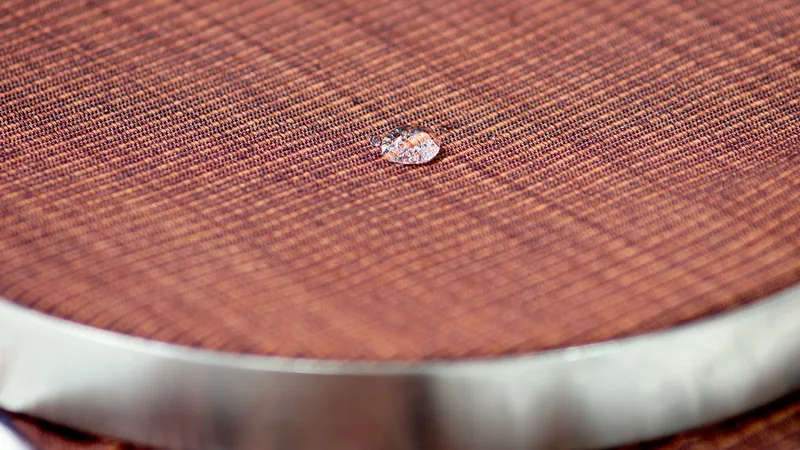
Water and oil repellent fabric is dyed or bleached cloth that has been finished (surface treated) so that both liquids — water and oil — bead up on the surface instead of soaking in or staining. It is a function designed for kitchens, food courts and food plants, where cloth meets water droplets, grease and food residue.
What is water and oil repellent fabric?
"Water and oil repellent" is a chemical treatment applied to the cloth surface after dyeing/bleaching, giving the face a very low surface energy so that neither water nor oil can spread into the fibres — they gather into droplets that can be wiped off or rolled away.
- Part of chemical finishing, done on dyed/bleached cloth
- Different from "waterproof" fabric, which needs a barrier that blocks water passing through the cloth — this finish protects against "surface wetting" only
- BCI offers the "water and oil repellent" finish as one of its chemical finishing services
Why oil "beats" a water-repellent finish easily
Water has a high surface tension (about 72 mN/m); oil has a much lower one (about 25-30 mN/m) — so cloth that already "repels water" may not yet repel oil. Research published in Nature Sustainability (2020) found that genuinely "oil-repellent" cloth needs specific design: repelling both water and oil normally relies on fluorinated (perfluorinated) chemistry or a dedicated surface design. The German textile research centre DTNW reports that making cloth oil-repellent "without fluorine" is still hard: general low-surface-energy treatments (e.g. PDMS) give only limited performance, and oil repellency varies significantly by oil type — which is why a kitchen spec must state both "which oil" and "which test".
Where is it used?
- Aprons and smocks for kitchens — water, oil and food residue bead up, wipe off easily, need less frequent laundering, and the fabric lasts longer
- Uniforms for food plants / hotel kitchens — jobs where cloth meets liquids often
- Seating upholstery, seat and table covers in restaurants — jobs that do not touch skin
- Home textile that meets both water and oil — e.g. kitchen curtains, sofa covers
How is water repellency tested?
- ISO 4920 (spray test) — cloth held at 45°, 250 ml sprayed within 25-30 seconds, the wetting pattern compared to a scale — grades 0-5 (0 = entire face wet, 5 = no wetting) — the standard states clearly that it tests "surface wetting", not penetration
- AATCC TM 22 — same principle, image scale 0, 50, 70, 80, 90, 100
- Name one standard in the spec and agree a "minimum value" with the mill — the "pass" value does not come from the standard, but from the agreement between buyer and mill
How is oil repellency tested?
- There is no single universal standard for "oil repellency" — the practice is to state the "liquid" and the "test method" in the spec
- Name the oils actually encountered (e.g. frying/vegetable oil), then choose the test: spray/drop (does the oil bead or spread) or measure contact angle — the higher the angle, the better the repellency
- The result depends on the "oil type" too (DTNW) — a value from one oil does not guarantee another
- Serious buyers: test with 2-3 oils actually used, then state a minimum per oil in the spec
The chemistry question: fluorinated vs PFAS-free
- Most "oil-repellent" finishes deliver with fluorinated (PFAS) chemistry, because these have very low surface energy (per the Nature Sustainability research)
- For "water" repellency, non-fluorinated (C0) chemistry is already in real use — but for "oil" repellency, C0 options are still in research (DTNW: no universal solution yet)
- Requirements: OEKO-TEX Standard 100 limits PFAS, including a "total fluorine" limit of 100 ppm that drops to 50 ppm in 2026; since October 2025 it also covers the French PFAS requirements (per Hohenstein)
- In practice: ask the mill which chemistry family the finish uses; if the product must hold OEKO-TEX Standard 100 certification, state it in the spec and ask for evidence (BCI holds this certification)
How to spec water and oil repellent fabric
- Fabric and fibre: uniforms/aprons that touch skin = TC or TR; seating/no skin contact = polyester — choose by the real use
- Water: standard + minimum (e.g. "ISO 4920 spray rating at least ...")
- Oil: the oils encountered + test method + minimum per oil
- Durability: state the wash count for the re-test — the finish wears away gradually with washing and abrasion
- Chemistry/certification: chemical requirements, e.g. OEKO-TEX Standard 100
- The minimum order (MOQ) for a finished job is negotiable
Does BCI do water and oil repellent finishing?
Boonchuay Industrial Co., Ltd. (BCI) — a commission dyeing and finishing mill in Nakhon Pathom with over 60 years of experience — offers "water repellent" and "water and oil repellent" finishing as part of its chemical finishing, with an in-house lab that tests water repellency to ISO, JIS, AATCC and Daimaru standards. On quality: BCI checks three checkpoints: greige inspection before dyeing, in-process control and inspection at packing, with a 10-point system quality report for every lot — so the buyer knows the test values of the actual lot, alongside ISO 9001, ISO 14001 and OEKO-TEX Standard 100 certifications. For the oil-side test method, the BCI team advises on the method and the liquid to match the job.
FAQ
Does "water-repellent" (DWR) cloth also repel oil?
Not necessarily — oil has much lower surface tension than water, so it spreads across the cloth surface more easily than water. Cloth that scores well on a spray test may still not be "oil-repellent" — the finish and an oil-side test must be stated separately.
What standard tests "oil repellency"?
There is no single universal standard — the practice is to state the "oil type" + "test method" (e.g. spray/drop or contact angle) + "minimum value" in the spec, then compare results between lots under the same conditions.
Can a C0 (fluorine-free) finish repel oil?
For water: already in real use; for oil: still in research (DTNW) — if you want PFAS-free, ask the mill which chemistry family is used, and ask for evidence/certification, e.g. OEKO-TEX Standard 100.
Which fabric for kitchens: TC, TR or polyester?
Uniforms/aprons that touch skin: TC or TR are the main picks; seating/cloth that does not touch skin: polyester — choose by the real use, the BCI team can advise (the MOQ is negotiable).
How many washes does the finish last?
It depends on the chemistry, the application and the wash conditions — there is no single number. State the "wash count used for the re-test" in the spec, then re-test before and after washing by the agreed method.
Talk to BCI
- Materials and functional finishes
- Uniform and workwear fabrics
- BCI's commission fabric dyeing service
- Contact the BCI sales team
References
- ISO 4920:2012 — Textile fabrics — Determination of resistance to surface wetting (spray test), ISO
- The Art of Testing: Water Repellency, AATCC
- Rational design of perfluorocarbon-free oleophobic textiles, Nature Sustainability (2020)
- PFAS — OEKO-TEX Standard 100 requirements, Hohenstein
- Fluorine-free oil repellency, DTNW