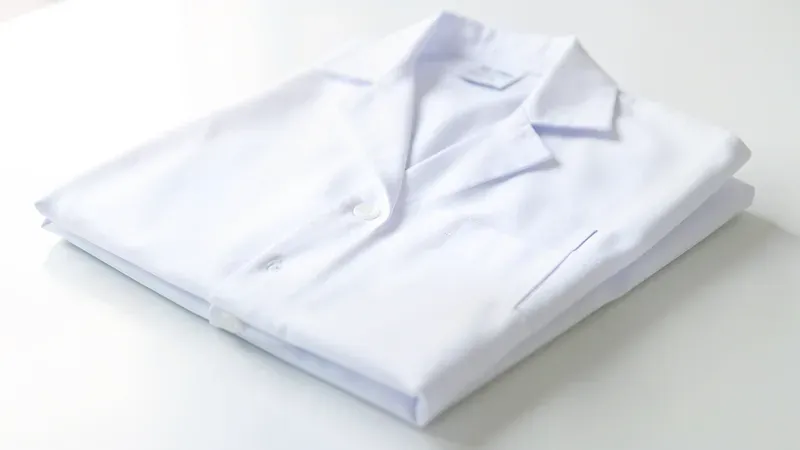
Lab coat fabric for routine workwear — hospitals, clinics and testing rooms — depends on fibre choice, pretreatment and agreed tests, not on a promise that any fabric stays white. Specify the fibre, finish and test methods, and test finished swatches before bulk production.
What "lab coat fabric" means here
This guide covers fabric for routine workwear. For a protective coat, follow the workplace’s hazard assessment and applicable finished-garment requirements.
Boonchuay Industrial’s hospital-fabrics page describes fabrics and finishes for clinical workwear. Confirm which options are available for your coat.
Fibre choice for routine workwear
- TC blends polyester and cotton.
- TR blends polyester and rayon. BCI’s TR uniform fabrics are typically heavier and softer than its TC fabrics.
- For 100% cotton, compare representative swatches at the specified weight and construction.
TC and TR are both main uniform fabrics. Compare finished swatches at the proposed fabric weight and construction under the intended wash conditions.
Finishes to specify, not to assume
Finishes are ordered per specification, and each finish needs its own agreed test method:
- Anti-bacterial-type finishes: specify the method and the test outcome you expect; do not read a finish listing as a clinical-protection claim.
- Water repellency: agree a method for measuring surface wetting.
- Soil release: agree on the stain and the test method.
- Mercerised and sanforised cotton: lustre, strength and pre-shrink control for cotton; these are fibre/pretreatment properties, not a wash-count rating.
Certified qualities carry OEKO-TEX® STANDARD 100 certification scoped to the fabric qualities they certify — not to the company as a whole and not to every product. For items in direct skin contact, the relevant OEKO-TEX Class 2 covers direct skin contact; Class 1 covers products intended for babies and children up to age three. Check the active certificate for the actual quality, not the company name.
Quality control before release
BCI has three checkpoints: greige inspection before dyeing, in-process control and inspection at packing. It provides a 10-point system quality report for every lot. Agree on any laboratory reports separately.
The in-house lab tests to ISO, JIS, AATCC and Daimaru methods. Confirm each test method and wash condition for the order.
Spec checklist before ordering
- Fibre and construction (TC, TR or 100% cotton), GSM and width.
- Finish (anti-bacterial, water-repellent, soil release) and the specific test method for each finish.
- Wash temperature, cycle expectations and the agreed dimensional change per ISO 5077 or equivalent agreed method.
- Colourfastness requirement (ISO 105-C06) and any other named standard for the coat.
- Certification requirement (e.g. OEKO-TEX Class 2 for direct skin contact) — confirm the active certificate for the actual fabric quality.
- Wash-and-dry expectation and the test method for the actual garment (ISO 6330 for domestic procedures; more specific industrial laundering conditions need their own spec).
Frequently asked questions
What tests should I specify? Consider laundering colourfastness (ISO 105-C06), dimensional change (ISO 5077 with specified wash and dry conditions), and any required finish test.
How do I compare TC and TR? Compare actual finished samples at the required weight and construction.
What does OEKO-TEX Product Class 2 cover? It applies to articles with direct skin contact. Check the active certificate for the exact fabric.
How should I handle chlorine exposure? Agree a separate test if the laundry uses chlorine. Discuss the intended laundry process with the supplier.
Is the minimum order negotiable? Yes, MOQ is negotiable.
Talk to BCI
For the published fabric range, see Boonchuay Industrial’s hospital fabrics and confirm laundering and test requirements for the order.