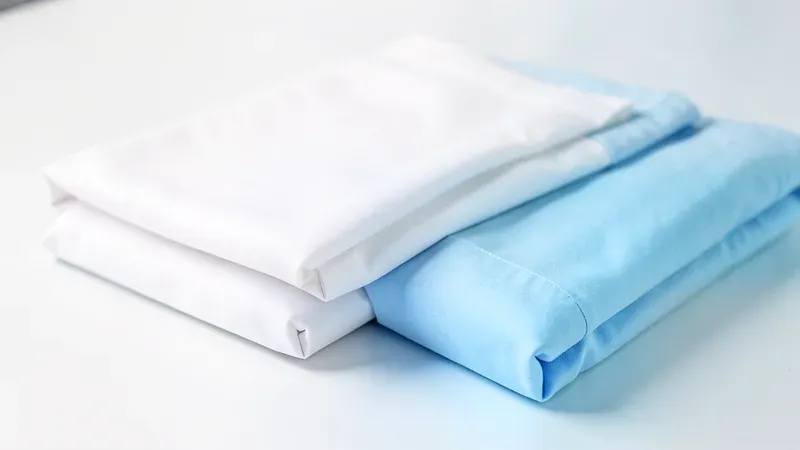
Specify bed linen and patient garments separately. Compare finished fabrics under the conditions used by the facility’s laundry.
Boonchuay Industrial lists fabrics for theatre uniforms, medical gowns and bandage coating. Ask the team to confirm whether it can supply the specific linen or patient garment fabric you need.
What "hospital fabric" means here
- Bed linen and plain patient-care textiles: sheets, pillowcases, blankets and draw sheets. Laundered in-house or by an industrial laundry on a frequent cycle.
- Patient garments and clinical-performance clothing: theatre uniforms, medical gowns and bandage fabric for coating. These may need named clinical-performance standards and certificates — a finished garment claim is separate from the fabric itself.
Set requirements separately for ordinary linens and for items with clinical performance requirements.
Fibre choice is a starting point, not a verdict
- TC blends polyester and cotton.
- TR blends polyester and rayon. BCI’s TR uniform fabrics are typically heavier and softer than its TC fabrics.
- For 100% cotton, compare representative swatches at the specified weight and construction.
- If considering 100% polyester, evaluate the actual finished fabric.
Laundering conditions decide the result
Ask the facility or laundry for its actual temperature, detergent and drying process. Agree on test conditions and allowable dimensional change before ordering.
- Dimensional change after agreed wash/dry conditions: ISO 5077 (or an agreed industrial equivalent).
- Domestic procedure ISO 6330: not an industrial laundering test.
- Colourfastness to laundering: ISO 105-C06 (or agreed method).
Finishes and certificates
- Anti-bacterial finish: state the method and the expected result; a finish listing is not proof of clinical protection.
- Water repellency: agree a method for measuring surface wetting.
- OEKO-TEX Product Class 2 covers direct-contact textiles such as bed linen. Product Class 1 covers products for children up to age three. Check the certificate for the fabric under consideration.
Quality control before release
BCI has three checkpoints: greige inspection before dyeing, in-process control and inspection at packing. It provides a 10-point system quality report for every lot. Specify any separate laboratory results required for acceptance.
Spec checklist
- Separate bed linen from patient garments.
- Fibre and construction, GSM and width.
- The facility's actual laundering conditions (temperature, cycle, detergent, drying).
- Dimensional-change method and target (ISO 5077 with agreed conditions).
- Colourfastness requirement (ISO 105-C06 or agreed method).
- Finish (anti-bacterial, water-repellent) and the specific test method for each.
- OEKO-TEX certificate if needed — confirm it for the actual quality.
- Bed linen, if this facility requires it, confirmed with BCI before writing the specification.
FAQ
How do I compare cotton and TC for bed linen? Compare finished specimens for feel and dimensional change after the agreed wash and drying cycle.
Can an antibacterial finish establish clinical protection? Clinical products require evidence for their intended use. Agree a test method and acceptance criterion for the finish itself.
Does OEKO-TEX Product Class 2 cover bed linen? Bed linen is an example of a direct-skin-contact article. Verify the active certificate for the exact fabric.
Can the certificate establish suitability for a particular clinical duty? Ask for the applicable finished-product test evidence for that duty.
Talk to BCI
For the published fabric range, see Boonchuay Industrial’s hospital fabrics and confirm laundering and test requirements for the order.