Specify wash durability by stating the property, wash-and-dry procedure and performance target. A test result applies to the fabric and conditions that were evaluated.
Match each property to a test
Choose a property-specific target and named test method for each requirement:
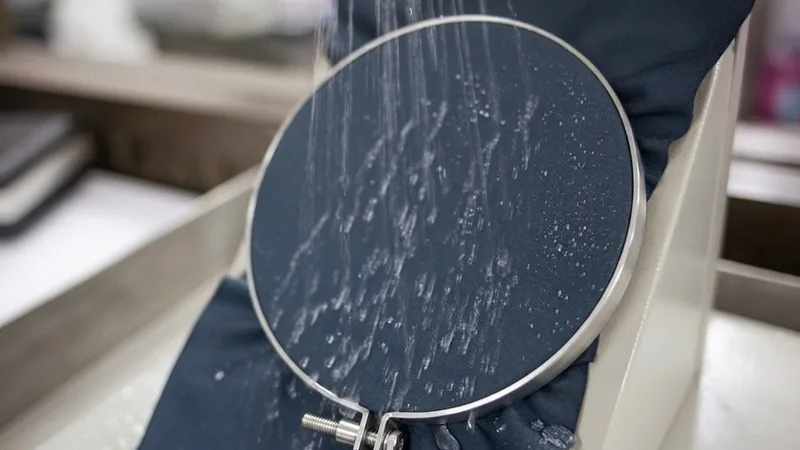
- Water repellency — a surface property. ISO 4920 (spray test, grades 0–5) measures resistance to surface wetting by water only; it does not measure oil repellency or predict rain penetration. Kowalski et al. (2022) tested five functional clothing materials after 1, 5 and 10 washes and reported gradual loss of water repellency under their study conditions. Specify water and oil repellency separately.
- Quick-dry and moisture management — separate properties: drying time/rate (how fast a specified amount of water leaves the fabric — AATCC TM199, TM200, TM201) versus liquid moisture management (how liquid spreads and moves across the surface — AATCC TM195). Each needs its own named method and target.
- Dimensional change — set a limit and measure it using ISO 5077 with a stated wash-and-dry procedure such as ISO 6330; ISO 6330 specifies the procedure, not the measurement.
- Anti-crease, soil release, antibacterial, antistatic — specify a target after repeated washing and agree a property-specific test method; do not infer wash durability from the finish name.
Specifying wash durability: target + number of washes + method
A testable spec has three parts:
- Target — the performance that must be retained (spray rating, dimensional change limit, fastness grade)
- Number of washes — how many standard wash-and-dry cycles the finish must survive
- Method — the wash-and-dry procedure (machine type, temperature, drying method, per ISO 6330) with the measurement method named
Pair each target with its named method:
- Dimensional change — ISO 5077 (wash/dry per ISO 6330)
- Colour fastness to washing — ISO 105-C06
- Crocking — ISO 105-X12
- Water repellency — ISO 4920 before and after washing
- Drying time / drying rate — AATCC TM199, TM200 or TM201
- Liquid moisture management — AATCC TM195
- Care-label alignment — the test method must match how the finished product will actually be laundered
Example spec lines (values are buyer-selected examples, not universal requirements):
- Water repellency: "spray rating (ISO 4920) ≥ 4 before washing; ≥ 3 after N standard wash-and-dry cycles per ISO 6330 (procedure stated)"
- Dimensions: "dimensional change not exceeding 2% (length and width) after wash-and-dry per ISO 5077 / ISO 6330 (procedure stated)"
- Colour: "fastness to washing (ISO 105-C06) and crocking (ISO 105-X12) at or above the agreed grade after N washes"
Agree the method with the mill before production starts, not after the fabric arrives: the value you measure depends on the method you choose.
How BCI tests finish durability
Boonchuay Industrial (BCI), based in Nakhon Pathom, has provided commission dyeing and finishing for over 60 years. The finishes described here — quick-dry, water repellent, water and oil repellent, soil release, antibacterial, antistatic and anti-crease — are within BCI's finishing scope.
BCI's in-house laboratory tests to ISO, JIS, AATCC and Daimaru standards. It covers, in-house: light, water, perspiration, washing (ISO 105-C06) and chlorine fastness; water repellent; rubbing (crocking, ISO 105-X12); tear/tensile; bleeding; and dimensional stability.
For after-wash finish verification — for example, a spray test after a defined number of launderings — put the sequence in the spec and confirm the test scope with the BCI team for your product; scope is agreed per order. For tests outside the in-house list (soil release, flame retardant, appearance after laundering), put the test in the spec and confirm it with the BCI team.
Every lot goes through three checkpoints: greige inspection before dyeing, in-process control and inspection at packing, with a 10-point system quality report for every lot.
FAQ
Q: Is a water-repellent finish permanent? A: No universal wash life applies. Kowalski et al. (2022) observed declining water repellency in five tested materials across 1, 5 and 10 washes under their study conditions. State the target and wash procedure in the spec, then agree how to verify it for your order.
Q: What is the difference between "quick-dry" and "water-repellent"? A: The ISO 4920 spray test measures resistance to surface wetting by water; quick-dry is how fast the fabric dries (AATCC TM199, TM200 or TM201). Liquid moisture management (AATCC TM195) is a separate property. Each needs its own target and named test.
Q: Can BCI test how long our functional finish lasts? A: The in-house lab covers the tests listed above, including fastness to washing (ISO 105-C06), water repellent, crocking (ISO 105-X12) and dimensional stability. An after-wash finish sequence — for example, testing water repellency after N standard washes — is agreed per order: put it in the spec and confirm the scope with the BCI team. Minimum order quantities are negotiable: share your lot size and end use, and the team will work with you.
Talk to BCI
If your fabric spec has to survive real use — repeated washing with the function still there — talk to the BCI team via the BCI contact page: commission dyeing and finishing to your spec, with an in-house laboratory for its listed tests; confirm other order-specific test scopes with the BCI team. See the Materials & Functional Finishes page, check what BCI commission dyeing covers, and if your spec is not complete yet, see the Fabric Spec Sheet.
References
- ISO 6330:2021 Textiles — Domestic washing and drying procedures for textile testing (BS EN ISO 6330:2021), BSI
- ISO 5077:2007 Textiles — Determination of dimensional change in washing and drying, ISO
- ISO 4920:2012 Textiles — Determination of resistance to surface wetting (spray test), ISO
- AATCC Standard Test Methods — TM195 (liquid moisture management), TM199–TM201 (drying time and rate), AATCC
- Kowalski, M. et al. (2022), Quality and Quantity Assessment of the Water Repellent Properties of Functional Clothing Materials after Washing, PubMed